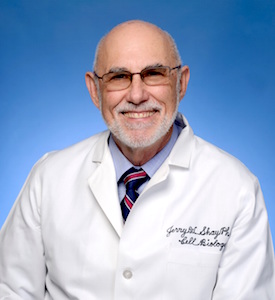
Jerry Shay, PhD
Professor of Cell Biology, University of Texas Southwestern Medical Center
I would like to congratulate the Mary Kay Ash Foundation on their 30th Anniversary. By way of introduction, I am a Professor at UT Southwestern Medical Center in Dallas and have a long-term interest in the relationship between aging and cancer. In addition to my own research and teaching at UT Southwestern, I have been volunteering to help the Mary Kay Ash Foundation since 2003. So how did I become involved with Mary Kay? This occurred when Michael Lunceford from Mary Kay asked for my advice about ideas to support cancer that affect women. Since almost all independent contractors that are associated with Mary Kay are women, this seemed to be an entirely appropriate area to support research. Since the Mary Kay Corporation’s home base is Dallas, I also thought this would be an area to give service back to my community.
Thus, we started a grant application process where we would invite medical schools around the country and research centers that focused on cancer research with the idea that only one application from each medical/research center would be allowed to compete for grant support. The thought was that each university could develop their own process for picking the most competitive applicant to compete for one of the grants. From the approximately 80-100 applications we get each year, Mary Kay’s Board of Directors generally funds the top 10-15 applicants, each for a $100,000 grant.
The problem is that evaluating 100 grants requires a significant amount of help and costs and I wanted to develop a system where the costs would be minimal so most of the funds would go for research. My solution to minimize administrative costs was to have the successful awardees each year serve as the scientific review panel for the next year. My role is to organize and moderate the mechanism for ranking each grant through a 2-step process. The first step is that the reviewers examine any of the 80-100 grants they believe they are qualified to review (only exception is that they cannot score a grant application from their own university). The scoring is identical to the NIH system where a score of one or two is considered outstanding while a score of eight or nine would be a grant application that is not competitive. All reviewers are familiar with this scoring system. After this first round, the Foundation team averages out all the scores and those in the top 20 are selected for the second round. Since we are not sure how many grants will be funded from year to year, I asked each of the reviewers to rank order each of the top 20 grant applications, with 1 being the best and 20 being the least competitive application. Once this is done we have a virtual meeting to discuss the rankings. Finally, I prepare a letter to Mr. Lunceford explaining the results. Some of the awarded applications are very basic cancer research and others are more translational, including some cancer clinical trials. This system has worked very well with minimal changes over the last 20 years. Most of the awardees are new investigators (e.g. Assistant Professors), but we have also awarded very prestigious scientists such as members of the National Academy of Science. All the awardees are from the United States but many of the independent contractors for Mary Kay are also international. Thus, there was a thought of how to fund scientists from abroad.
About 6 years ago I was approached by the Mary Kay Ash Foundation to provide ideas about a mechanism to support international cancer research. I suggested that a critical need was to support the best postdoctoral trainees from abroad. These would be recent PhD graduates interested in a career in cancer. Thus, Mary Kay decided to award my university, UT Southwestern, a 5-year training grant to support up to 5 international scholars each year to work in labs conducting cancer research. We have over 200 cancer researchers at UT Southwestern with broad interests in cancer so it was easy to place potential postdoctoral trainees in excellent labs. Once we received an application from a trainee interested in the Mary Kay International Postdoctoral Scholars program, we asked the applicant to pick 3-4 labs they may be interested in conducting research for 2 or more years. These interviews were done virtually and once the applicant and the potential mentor were matched we then covered the costs of the scholar traveling to the U.S. and paid their stipend plus some research funding. At the end of their fellowship our hope was that they would return to their home country and set up their own lab. The need for cancer research progress is not just a U.S problem and we need a global community of top scientists to work on specific types of cancer to reduce the overall morbidity and mortality from cancer. Even though we are making excellent progress, this is a long-term problem and the hope is within the next decade, we will continue to make major impacts and hopefully find cures for many types of cancer that mostly affect women. While this postdoctoral program ended in 2025, there were many trainees who published high profile manuscripts that have the potential to find new treatments for cancer. Trainees came from multiple countries including Brazil, Germany, Mexico, Portugal, Spain and Singapore.
I should point out that I have neither requested nor taken any funds from Mary Kay for my own research program. However, the Mary Kay senior leadership funded a Distinguished Professorship in my honor to UT Southwestern a few years ago for which I am extremely grateful. In summary, it has been an honor to work with the staff at MKAF. I would like to point out Julia Santosuosso, who oversees the Social Impact Program at MKAF, does most of the heavy lifting making my job a lot easier. I would also like to thank Michael Lunceford for his vision and trust in me to help improve treatment of women with cancer.